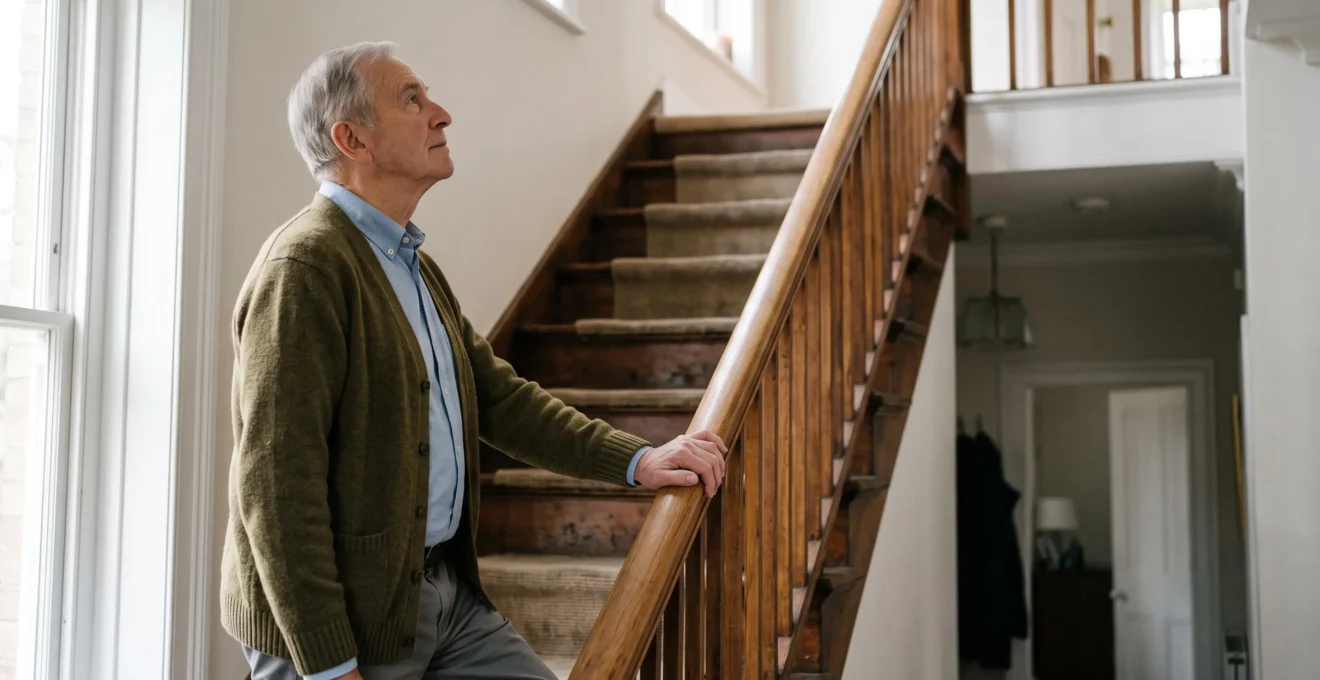
Contrary to popular belief, difficulty with stairs is not just a sign of weak legs; it’s a critical early warning of declining muscle *power*, a specific loss that rapidly predicts a cascade of functional decline.
- The inability to climb stairs is a proxy for losing the explosive strength needed for everyday actions like getting up from a chair or preventing a fall.
- Specific, measurable ‘functional thresholds’—like how fast you walk or how many times you can stand from a chair—are far better predictors of future independence than vague feelings of weakness.
Recommendation: Shift your focus from generic exercise to targeted activities that rebuild muscle power, and proactively adapt your home *before* a crisis to significantly extend your years of independent living.
The moment you pause at the bottom of a staircase, weighing the effort it will take to ascend, is more than just a fleeting hesitation. For many seniors and their families, it’s a tangible, often daily, reminder of changing physical abilities. The common response is to attribute this to simple ageing or weakening leg muscles, a problem to be solved with a bit more walking or by simply avoiding stairs. This perspective, however, misses the critical diagnostic message that this challenge is sending. It’s a fundamental misunderstanding of the problem.
The struggle with stairs is rarely an isolated issue. It is a highly visible symptom of a deeper, more systemic change: the loss of muscle power, not just strength. This is the ability to generate force quickly, which is essential for countless activities we take for granted. While general advice focuses on fall prevention and staying active, it often fails to address this specific, measurable decline that serves as a powerful predictor for losing the ability to perform other activities of daily living. Ignoring this signal is like ignoring a check engine light that is specifically warning of imminent transmission failure.
This article reframes the conversation. Instead of viewing stair-climbing difficulty as an endpoint, we will treat it as a crucial data point. We will explore the specific functional abilities that are the true canaries in the coal mine for independence, deciphering what they tell us about underlying physical health. By understanding the ‘why’ behind the struggle, we can move beyond generic advice and develop a precise, proactive roadmap for targeted exercises, environmental adaptations, and strategic support systems. The goal is not just to manage decline, but to actively preserve and prolong the independence you value.
In the following sections, we will break down exactly what to monitor, how to maintain the specific strength you need, and when to strategically accept help to ensure you remain in control of your life for as long as possible.
Summary: Why Losing the Ability to Climb Stairs Predicts Losing Independence Within 5 Years?
- Which Everyday Abilities Should You Monitor Most Closely to Predict Future Independence?
- How to Keep the Strength for Carrying Shopping, Climbing Stairs, and Getting Up From Chairs?
- Home Exercise, Physiotherapy, or Activity Groups: Which Best Maintains Your Independence?
- The Subtle Signs You’re Losing Function That Most People Notice Too Late?
- How to Modify Your Routine and Home to Stay Independent 10 Years Longer?
- Which Aspects of Ageing Can Prevention Actually Slow: Mobility, Memory, or Both?
- What Home Care Services Actually Exist Beyond What You See in Dramatic TV Programmes?
- When Does Accepting Help at Home Actually Help You Stay Independent Longer?
Which Everyday Abilities Should You Monitor Most Closely to Predict Future Independence?
While the inability to climb stairs is a dramatic red flag, it’s the final expression of a gradual decline in more fundamental abilities. To predict and prevent the loss of independence, you must monitor the subtle, measurable precursors. These are the functional thresholds that separate safe, independent living from a state of increasing risk and dependency. Forget vague feelings of weakness; focus on these concrete benchmarks.
One of the most telling, yet often overlooked, indicators is grip strength. It’s a powerful proxy for overall muscle health and frailty. The simple act of gripping a handrail, as shown below, engages a complex system of muscles that reflects your body’s overall condition. Research confirms that this ability diminishes significantly with age. Another key area is balance and lower-body power. A landmark study identified three critical tests that reliably predict stair-climbing ability in older adults. These aren’t complex medical evaluations but simple actions you can observe at home: maintaining a gait speed of about 0.7 m/s, being able to stand on one leg for over 5 seconds, and the ability to complete five chair stands without using your hands for support. Falling below these thresholds indicates a significant shift in functional capacity.
These metrics—gait speed, single-leg stance, and chair-stand repetitions—are your personal early-warning system. They are far more predictive than simply noting that stairs “feel harder.” A study published in MOJ Gerontology & Geriatrics on functional predictors of stair climbing highlighted these specific measures as the dividing line between those who can navigate their environment independently and those who begin to avoid essential activities. Monitoring these specific abilities provides actionable data, allowing you to intervene long before a major function like stair climbing is lost entirely.
How to Keep the Strength for Carrying Shopping, Climbing Stairs, and Getting Up From Chairs?
Maintaining the ability to carry shopping, climb stairs, or rise from a chair is not about brute strength; it’s about muscle power. This is the crucial distinction that most generic fitness advice misses. Strength is the ability to exert force, like lifting a heavy weight slowly. Power is the ability to exert that force *quickly*—the explosive movement needed to push yourself up from a seated position or to quickly shift your balance to prevent a fall. Age-related decline in muscle power, known as dynapenia, is a more significant predictor of functional loss than the decline in muscle strength (sarcopenia) alone.
Therefore, your exercise regimen must specifically target power. While walking is excellent for cardiovascular health, it does little to build the explosive strength needed for these critical tasks. The most effective exercises involve movements that mimic these daily challenges. The “sit-to-stand” exercise is a perfect example. It directly trains the neuromuscular pathways and major muscle groups (glutes, quadriceps) responsible for getting up from a chair, which is the foundational movement for climbing stairs and maintaining mobility.
By focusing on the speed of the “stand-up” phase of the movement (while maintaining control), you are actively training power. This type of resistance training is proven to be one of the most effective interventions to counteract age-related muscle and power loss. The goal is not to become a weightlifter, but to preserve the functional power that underpins nearly every act of independence.
Action Plan: The Foundational Sit-to-Stand Power Exercise
- Sit on a sturdy, non-sliding chair with feet flat on the floor and a stable surface within reach for support.
- Scoot forward so you are seated at the front edge of the chair.
- Lean your chest forward over your toes, shifting your body weight forward.
- Squeeze your glutes and rise to a stable standing position, using your hands only if necessary.
- Slowly sit back down with control and repeat for 10 repetitions. Aim for a powerful, quick ascent and a slow, controlled descent.
Home Exercise, Physiotherapy, or Activity Groups: Which Best Maintains Your Independence?
Choosing the right setting for exercise is as important as choosing the right exercises. While home exercises offer convenience and physiotherapy provides targeted, one-on-one correction, the power of group activities is often underestimated. The best approach frequently involves a combination, but ignoring the social component can mean missing a powerful lever for maintaining long-term function. The decision depends on your current functional level, your personality, and your specific goals.
Physiotherapy is the essential starting point if you are recovering from an injury, experiencing pain, or have a significant fear of falling. A therapist can provide a precise diagnosis of your functional deficits—be it poor balance, lack of ankle mobility, or weak hip abductors—and prescribe a safe, corrective exercise program. This is the clinical, targeted intervention that lays a safe foundation.
Home exercises are the backbone of consistency. This is where you put the therapist’s plan into practice daily, building the habits that lead to lasting change. However, motivation can wane when exercising alone. This is where the third option becomes critical. Activity groups—whether a tai chi class, a walking club, or a senior’s gym program—provide social connection and accountability, two powerful motivators. This is not just a “nice-to-have” feature; it has a direct physiological impact. A longitudinal NHATS analysis found that grip strength decreased significantly by 2.046 kg over a 4-year period, with socially isolated older adults showing markedly lower grip strength. Social engagement is not separate from physical health; it is integral to it.
The optimal strategy, therefore, is often a hybrid one. Use physiotherapy to get a professional assessment and a safe, tailored plan. Perform the core exercises at home to build consistency. But critically, join a group activity to foster motivation, create social bonds, and combat the insidious effects of isolation. This three-pronged approach addresses the body, the habit, and the mind, creating the most resilient defence against the loss of independence.
The Subtle Signs You’re Losing Function That Most People Notice Too Late?
Long before you consciously avoid the stairs, your body sends out subtle signals that a functional shift is underway. Recognizing these early warnings is the key to proactive intervention. Most people dismiss them as minor annoyances or normal parts of ageing, but a rehabilitation consultant sees them as critical data points. The problem is that many only seek help after a fall or a significant loss of function, when regaining ground is much harder.
One of the earliest signs is a change in how you use your environment for support. Do you find yourself placing a hand on the wall as you turn a corner? Do you instinctively reach for furniture to steady yourself when you stand up? This is called “environmental anchoring,” and it’s a subconscious compensation for declining balance or power. Another subtle sign is a hesitation or a mental “gearing up” before performing a routine physical task, like getting out of a low car seat. This pause indicates that the movement is no longer automatic and now requires conscious effort and planning.
Difficulty descending stairs is often a more telling sign than difficulty climbing up. A study of community-dwelling older adults found that more than 45% reported difficulty climbing stairs, but difficulty in both ascending and descending was a much stronger predictor of future limitations in activities of daily living. As Lora Stutzman, a physical therapist at Johns Hopkins, notes, this feeling of unsteadiness is a primary concern:
We treat elderly adults for injuries sustained from falls, and other patients who feel unsteady while walking or standing and are fearful of falling.
– Lora Stutzman, Johns Hopkins Medicine
This fear is not just psychological; it’s a valid response to real changes in your neuromuscular system. Other subtle signs include walking more slowly on uneven surfaces, having difficulty carrying a bag of shopping while walking, or needing to “push off” with your arms to get out of a comfortable sofa. Each of these is a small clue that the automatic, powerful responses that keep you stable are beginning to erode.
How to Modify Your Routine and Home to Stay Independent 10 Years Longer?
Preserving independence is not just about strengthening your body; it’s about intelligently shaping your environment to reduce unnecessary physical demands. This is not a sign of surrender but a proactive strategy to conserve energy for the activities you love. A well-modified home acts as a silent partner, reducing the risk of a catastrophic fall and making daily life safer and less taxing. The evidence is clear: simple, targeted modifications can have a profound impact.
The goal of home modification is to create a “low-demand” environment. This starts with the two biggest culprits for falls and functional difficulty: poor lighting and clutter. Increasing wattage in hallways and stairwells and ensuring clear, wide pathways are the most effective, low-cost changes you can make. The next step is adding support where it’s most needed. Handrails on both sides of a staircase are non-negotiable. Grab bars in the bathroom—by the toilet and in the shower—provide stability during transfers, which are high-risk moments. A systematic review provides strong evidence that home modifications are associated with a 38% reduction in falls among older adults. It’s one of the most powerful preventative tools available.
Beyond structural changes, routine modifications are key. If carrying laundry up the stairs is becoming a challenge, split it into two smaller, lighter loads. If preparing a meal leaves you exhausted, consider a stool to sit on while chopping vegetables. Arrange your kitchen so the most frequently used items are on the counter or an easily accessible shelf, not in high or low cupboards. Each small adjustment reduces the cumulative physical load of your day, preserving your functional capacity for years to come.
Your Essential Home Safety Audit Checklist
- Clear walkways of loose items, cords, and furniture that create trip hazards.
- Install handrails on both sides of stairs and in long hallways.
- Add grab bars in the bathroom near the toilet, in the shower, and by the tub.
- Improve lighting throughout the home, especially on stairs, in hallways, and at entrances.
- Arrange a professional in-home safety assessment from an occupational therapist to identify remaining, less obvious hazards.
Which Aspects of Ageing Can Prevention Actually Slow: Mobility, Memory, or Both?
A common and dispiriting myth is that the core processes of ageing—declining mobility and fading memory—are inevitable and irreversible. While it’s true that some age-related changes are unavoidable, a growing body of research shows that targeted preventative measures can significantly slow the trajectory of decline in both the physical and cognitive realms. The connection between the two is much stronger than most people realize; preserving one often helps preserve the other.
On the mobility front, we know that consistent, targeted exercise can dramatically slow the loss of muscle power and bone density. This is the most direct intervention against frailty. But the benefits don’t stop at the muscles. A fascinating study led by Erickson and colleagues found that regular exercise can actually increase the size of the hippocampus, a brain region critical for memory. Elderly adults who exercised for a year showed measurable growth in this area, directly linking physical activity to the structural integrity of the brain’s memory centre. This happens partly through an increase in a protein called Brain-Derived Neurotrophic Factor (BDNF), which acts like a fertilizer for brain cells.
This demonstrates that mobility and memory are not two separate battles; they are fought on the same field. The factors that cause mobility to decline are often associated with cognitive decline as well. A 10-year trajectory analysis of older adults revealed that those who experienced a faster decline in gait speed or grip strength were also more likely to have cognitive impairment. Therefore, the very same activities that preserve your ability to climb stairs—exercises that challenge your muscles, balance, and coordination—are also stimulating the brain systems that support memory and cognitive function. Prevention is not a futile effort; it is a powerful strategy that can measurably slow the ageing process across multiple domains, allowing for a longer, higher-quality period of independence.
What Home Care Services Actually Exist Beyond What You See in Dramatic TV Programmes?
The term “home care” often conjures dramatic images from television: round-the-clock nurses and a complete loss of personal autonomy. The reality is far more nuanced, practical, and preventative. Modern home care is a broad spectrum of services designed not to take over, but to provide targeted support that bridges the gap between full independence and the need for residential care. These services are tools to *extend* independence, not signify its end.
Home care services can be broadly divided into three categories. First is Companion Care or homemaker services. This can be as simple as having someone come for a few hours a week to help with housekeeping, meal preparation, shopping, or transportation to appointments. This isn’t about personal care; it’s about offloading the instrumental tasks that have become physically demanding, freeing up your energy for more enjoyable activities.
Second is Personal Care Assistance. This involves hands-on, non-medical help with activities of daily living (ADLs), such as bathing, dressing, and grooming. This level of support is for when safety during these intimate tasks becomes a concern. It can be arranged for as little as an hour a day to help with the morning routine, preserving dignity and preventing falls in the most vulnerable part of the home—the bathroom.
Finally, there are Skilled Nursing and Therapy Services at home. This is what most people think of—a registered nurse providing wound care, a physiotherapist guiding rehabilitation after a hospital stay, or an occupational therapist performing a home safety assessment and implementing modifications. Programs like the “Safe At Home” initiative demonstrate how even moderate, preventative interventions, like providing a few thousand dollars in home modifications, can significantly reduce fall risk and fear of falling, keeping people safely in their own homes. These services are often short-term, designed to help you regain function and establish a safe routine.
Key Takeaways
- Stair-climbing difficulty is a key diagnostic signal of declining muscle *power*, not just strength, which is a leading predictor of broader functional loss.
- Monitoring specific ‘functional thresholds’ like gait speed, single-leg balance, and chair-stand repetitions provides a more accurate early warning than vague feelings of weakness.
- Accepting targeted help and making proactive home modifications are strategic investments to prolong independence, not signs of failure.
When Does Accepting Help at Home Actually Help You Stay Independent Longer?
Perhaps the single greatest barrier to prolonging independence is the perception that accepting help is a sign of failure. This mindset is not only incorrect; it is dangerous. It often leads individuals to delay seeking support until after a crisis, such as a serious fall, at which point recovery is far more difficult and a complete loss of independence is a real possibility. The strategic time to accept help is long before you think you desperately need it.
Accepting help is a proactive investment in your “independence runway.” Think of your daily energy and functional capacity as a finite resource. When tasks like house cleaning, grocery shopping, or even bathing become physically taxing and risky, you are depleting that resource on low-value, high-risk activities. By strategically delegating these tasks to a home care assistant for a few hours a week, you conserve your energy for high-value activities that bring you joy and maintain social connections, like visiting with family, attending a club, or working in the garden. It is an act of resource management. The statistics on falls are sobering; CDC data cited by fall-prevention researchers shows that every 11 seconds an older adult is treated in an emergency room for a fall. Using help to avoid becoming part of that statistic is a profoundly intelligent choice.
Help is most effective when it is introduced to prevent a specific risk. If you notice you’re becoming unsteady in the shower, that is the moment to bring in an assistant for just that task. If you’re skipping meals because cooking is too tiring, that is the moment to arrange for meal preparation. This targeted approach preserves your autonomy in all other areas of life while shoring up the one area of weakness. Waiting until you can no longer manage multiple activities of daily living is a reactive posture that surrenders control. Embracing support early, on your own terms, is the ultimate expression of control over your future.
By understanding that the struggle with stairs is a critical diagnostic signal, you can shift from a reactive to a proactive stance. Preserving your independence is an active, strategic process of monitoring your functional thresholds, building targeted muscle power, and intelligently adapting your environment. The next logical step is to create a personalized plan based on these insights. Assess your own functional benchmarks, identify the highest-risk tasks in your daily routine, and begin implementing the small changes that will collectively secure your independence for years to come.