If land-based exercise feels like a battle against your own body, the problem might not be your joints—it might be gravity itself. Water offers more than just a low-impact workout; its unique physical properties actively support your body, reduce pain, and create a safe environment to reverse physical deconditioning. This guide explains the science behind aquatic freedom and provides a practical path to get you back to moving with confidence.
The familiar ache in a knee, the sharp complaint from a hip, the general stiffness that makes even walking feel like a chore. For many seniors, the relationship with exercise becomes a frustrating cycle: you know you should move, but movement hurts. Doctors and well-meaning family suggest “taking it easy,” but this often leads to a downward spiral of inactivity, lost strength, and even more pain. You might feel that your body has failed you, closing the door on the active life you once enjoyed.
Most advice focuses on generic “low-impact” activities, but rarely explains why they work. The common wisdom is that water exercise is good for arthritis, but this statement barely scratches the surface. It misses the fundamental, transformative power of the aquatic environment. What if the solution wasn’t just a gentler workout, but a completely different physical reality? What if you could step into a world where gravity’s hold on your joints is released, where pain subsides, and where you can rebuild strength without fear of a fall?
This is the true promise of water-based exercise. This article moves beyond the platitudes to explore the “physics of freedom” that water provides. We will delve into how water’s properties of buoyancy and hydrostatic pressure work to support your body in ways air simply cannot. We will tackle the practical and emotional barriers—from not knowing how to swim to feeling self-conscious in a bathing suit—and provide a clear roadmap for starting. This is your guide to understanding how water can help you distinguish between irreversible ageing and reversible deconditioning, putting you back in control of your health and mobility.
This article will guide you through the science, the practical first steps, and the mindset shifts needed to embrace aquatic exercise. The following sections break down everything you need to know to move from pain-limited to possibility-unlocked.
Summary: Why Can You Exercise in Water When Land-Based Movement Hurts?
- What Does Water Actually Do for Your Joints, Muscles, and Heart That Air Cannot?
- How to Begin Pool Exercise When You Haven’t Swum in 30 Years or Cannot Swim at All?
- Aqua Aerobics, Lap Swimming, or Hydrotherapy: Which Water Exercise Suits Your Needs?
- How to Overcome Embarrassment, Changing Room Challenges, and Pool Access Problems?
- How to Create a Weekly Pool Routine When Sessions Are Limited and Travel Is Difficult?
- What Makes “Senior-Friendly” Exercise Actually Different From Regular Workouts?
- How Much of Your Lost Stamina Is Ageing and How Much Is Deconditioning You Can Reverse?
- Why Does the Exercise Programme That Works for Your 40-Year-Old PT Fail Your 70-Year-Old Body?
What Does Water Actually Do for Your Joints, Muscles, and Heart That Air Cannot?
On land, every step you take sends impact forces through your feet, knees, and hips. For a body with arthritis or joint pain, this constant battle with gravity is exhausting and painful. Water changes the rules of this engagement entirely. It’s not just “softer” than land; it provides a unique combination of physical forces that creates what can only be described as the “physics of freedom” for an aching body.
The first and most obvious force is buoyancy. When you stand in chest-deep water, your body is bearing only about 10-20% of its actual weight. This incredible unloading effect lifts the pressure off your joints. A knee that screams in protest during a walk on pavement can move through a full, pain-free range of motion when submerged. This allows you to strengthen the muscles around the joint without aggravating the underlying condition.
The second, less-understood force is hydrostatic pressure. This is the gentle, constant pressure the water exerts on your submerged body from all sides. Think of it as a full-body compression stocking. This pressure helps reduce swelling in the lower limbs, improves circulation, and can even have a calming effect on the nervous system. The sensation of being held and supported by the water decreases pain signals and fosters a sense of security.
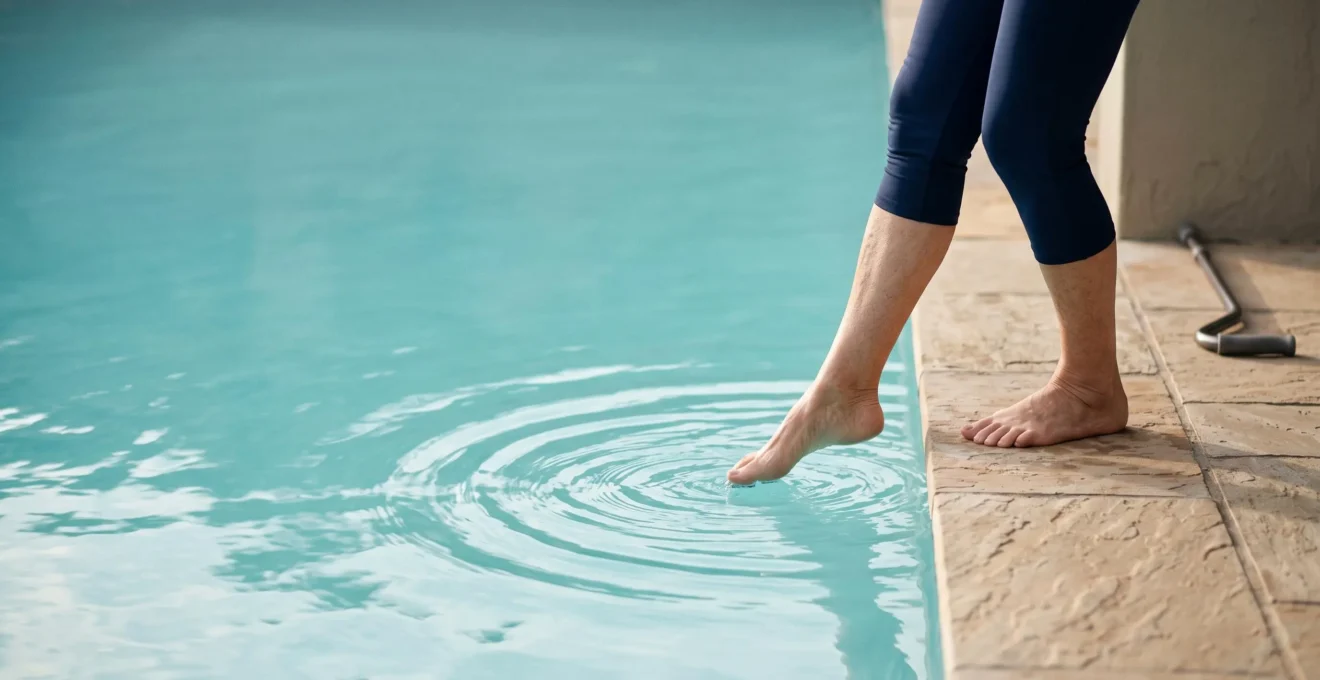
As the image above illustrates, water’s interaction with the skin is constant and total. Finally, there’s viscosity, or water’s natural resistance. Unlike lifting a weight, where resistance is high in one direction and non-existent in the other, water provides a smooth, consistent resistance in all directions of movement. Pushing your hand forward is a workout, and pulling it back is also a workout. This makes it a uniquely safe and effective way to build balanced muscle strength without any sudden, jarring forces.
In essence, water creates the ideal therapeutic environment: it reduces joint load, decreases swelling, and provides safe, 360-degree resistance to rebuild strength. It corrects the body-environment mismatch that makes land-based exercise so difficult.
How to Begin Pool Exercise When You Haven’t Swum in 30 Years or Cannot Swim at All?
The image of a pool often brings to mind strenuous lap swimming, but the reality of water exercise for health is very different. One of the most common and powerful misconceptions is that you need to be a swimmer to benefit. In fact, for many therapeutic aquatic programs, swimming ability is not required at all. Most arthritis water exercises are performed while standing in waist-to-chest-deep water, often with the support of the pool’s edge readily available. This ensures you feel secure and in control at all times.
The initial focus should be on comfort and familiarity, not performance. The first few visits might simply involve walking back and forth in the shallow end to get used to the sensation of the water’s support and resistance. Flotation devices are excellent tools for building confidence. A simple foam “noodle” tucked under your arms or a flotation belt worn around your waist can provide all the support you need to feel secure while you explore movements like aqua jogging or leg lifts in slightly deeper water.
It’s crucial to listen to your body. The golden rule is to never push through pain. Water’s resistance is variable: the slower your movements, the less resistance you will encounter. As you get stronger, you can increase the speed and intensity. The goal is to re-learn movement in a safe space, gently challenging your muscles and joints without causing a flare-up. An ideal pool temperature for this kind of exercise is between 83-88°F (28-31°C), as the warmth helps to relax muscles and soothe stiff joints.
Action Plan: Your First Pool Session Audit
- Identify Needs: List your main goals (e.g., pain relief, cardio, balance) and physical limitations (e.g., non-swimmer, poor balance) to find the right class.
- Research Local Pools: Call local community centers or gyms to find pools with warm water (83-88°F), accessible changing rooms, and specific senior or arthritis aquatic programs.
- Gather Your Gear: Assemble a comfortable swimsuit, non-slip pool shoes for the deck, a towel, and a lock. A long, absorbent robe can provide warmth and confidence walking to and from the pool.
- Plan Your First Visit: Choose a quieter, off-peak time if possible. Set a simple, achievable goal: just get in the water and walk for 10-15 minutes.
- Post-Session Review: After your visit, take note. How did your joints feel during and after? What part of the experience was easiest? What was a challenge? Use this to adjust your plan for next time.
Remember, the first step is the hardest. By setting a small, manageable goal, you transform a daunting prospect into a simple, positive action.
Aqua Aerobics, Lap Swimming, or Hydrotherapy: Which Water Exercise Suits Your Needs?
Once you’re comfortable in the water, a world of options opens up. Choosing the right activity depends entirely on your personal health goals, fitness level, and what is available in your community. The three main categories are clinical hydrotherapy, group aqua aerobics, and traditional lap swimming, each serving a distinct purpose.
Hydrotherapy, often conducted under a program like the Arthritis Foundation Aquatic Program (AFAP), is the most structured and therapeutic option. These are typically small-group classes led by a certified instructor in warm water (83°F or higher). The focus is squarely on improving range of motion, reducing stiffness, and building functional strength in a controlled environment. It’s an excellent starting point for those with significant pain, post-surgery recovery needs, or a fear of movement.
Aqua Aerobics is a more general fitness class, focusing on cardiovascular endurance and overall strength. While still low-impact, the intensity can be higher than in a hydrotherapy session. These are great for building stamina and are widely available in public pools, making them a sustainable long-term fitness habit. To maximize the benefits for arthritis, studies suggest that 2-3 sessions of 30-45 minutes per week is an optimal frequency.
Lap Swimming is a fantastic cardiovascular workout but requires swimming proficiency and is less focused on specific joint-related issues. While it builds excellent endurance, the repetitive motions may not be ideal for certain types of shoulder or neck pain. It is best suited for those who are already confident swimmers and are looking to build independent fitness.
As you explore these options, don’t be afraid to get creative with your movements. As one expert highlights, even simple changes can have a big impact. In a discussion on water exercises for arthritis, Mary Sanders, PhD, pointed out a unique technique:
Research from Japan shows that walking backward in the water engages more muscles, especially around the spine, quads and shins, while also boosting heart rate.
– Mary Sanders, PhD, Arthritis Foundation – Water Exercises for Arthritis
To help you decide, the following table breaks down the primary benefits of each activity based on common goals.
| Primary Goal | Hydrotherapy (Clinical AFAP) | Aqua Aerobics | Lap Swimming |
|---|---|---|---|
| Reduce joint pain / arthritis stiffness | ✔ Supervised, warm water program | ✔ Moderate | △ Limited |
| Improve walking stamina / cardio endurance | △ Limited | ✔ Good | ✔ Excellent |
| Recover post-surgery (hip/knee) | ✔ Instructor-guided, structured | △ With modification | ✘ Not recommended initially |
| Build independent long-term fitness habit | △ Time-limited (6-10 weeks) | ✔ Sustainable, public pool | ✔ Sustainable, requires swim skill |
Ultimately, the best exercise is the one you enjoy and can do consistently. Start with the option that feels safest and most appealing, and know that you can always adapt as your strength and confidence grow.
How to Overcome Embarrassment, Changing Room Challenges, and Pool Access Problems?
The physical benefits of water exercise are clear, but often, the biggest hurdles are not in the pool but in our own minds and in the logistics of getting there. Acknowledging these “logistical hurdles” is the first step to overcoming them. Feelings of embarrassment, challenges with changing rooms, and difficulties with transport are real, valid concerns that stop many people before they even start.
Feeling self-conscious in a swimsuit is an incredibly common fear. The key is to shift your focus. Remind yourself that you are there for your health and well-being, not for a fashion show. In a senior or therapeutic aquatics class, everyone is in the same boat—focused on their own movement and finding relief, not on judging others. Investing in a comfortable, well-fitting swimsuit and a long, absorbent robe can do wonders for your confidence walking to and from the pool deck. You are there to feel good, not just to look a certain way.
Changing rooms can present their own set of challenges, especially for those with mobility or balance issues. Call the facility ahead of time to ask about their accessibility. Do they have private or family changing rooms? Are there benches in the stalls and showers? Are there non-slip mats on the floor? Going during off-peak hours can mean a less crowded and rushed experience. Pack your bag strategically with slip-on shoes for the wet floor and a plastic bag for your wet suit to make the process smoother.
Finally, there’s the issue of access. If driving is difficult, look into community transport services for seniors or ride-sharing options. See if a friend or neighbor might be interested in joining you, turning the trip into a social outing. If the local pool is too far or too expensive, some physical therapy clinics have smaller therapeutic pools and may offer community access times. The goal is to identify the specific barrier and brainstorm a practical, one-step solution.
Every small victory in overcoming these hurdles builds momentum. By planning ahead and focusing on your “why,” you can transform these barriers from stop signs into manageable speed bumps on your path to better health.
How to Create a Weekly Pool Routine When Sessions Are Limited and Travel Is Difficult?
For many seniors, the ideal of attending pool sessions multiple times a week isn’t realistic due to limited class schedules, transportation challenges, or sheer fatigue. The good news is that consistency trumps frequency. A single, well-structured pool session each week can deliver significant benefits, especially when you are just starting to rebuild your fitness.
The key is to make that one session count. Think of it like a formal fitness class, with a clear structure. Every session should include a warm-up (5-10 minutes of gentle walking and large, slow movements), a main segment (20-30 minutes focused on your goals), and a cool-down (5-10 minutes of slow walking and gentle stretching). For the main segment, you could focus on cardiovascular health with aqua jogging or on strength with resisted leg and arm exercises. The structure ensures you get a balanced, safe, and effective workout.
As you become more comfortable, you can integrate principles from more advanced protocols. For example, Deep Water Running, performed with a flotation vest, is a no-impact activity that is highly effective. As one physical therapist noted about this type of exercise:
It’s especially beneficial for my patients who are struggling to lose weight and find traditional exercises uncomfortable or even painful. The no impact nature of the workouts allows people of all ages, abilities and fitness levels to participate.
To make the routine stick, build it into your weekly schedule. “Habit stacking” is a powerful technique: pair your pool visit with an activity you already do. For example, “Every Tuesday after my grocery shopping, I will go to the pool.” This links the new habit to an existing one. If possible, find a structured program. Many, like the Arthritis Foundation Aquatic Program, operate on a defined schedule, with classes meeting two to three times per week for a set number of weeks. This built-in commitment can be a powerful motivator.
Ultimately, a less-than-perfect routine that you can stick with is infinitely better than a “perfect” routine that you can’t maintain. Start with one successful visit a week and build from there.
What Makes “Senior-Friendly” Exercise Actually Different From Regular Workouts?
The term “senior-friendly” exercise is often misinterpreted as simply being “easier.” This misses the point entirely. A well-designed exercise program for an older adult is not about lower effort; it’s about a smarter, more strategic focus. While a younger person’s workout might prioritize muscle size or peak cardiovascular output, a senior’s program must prioritize functional strength, stability, and fall prevention.
The primary difference lies in the components of fitness that are emphasized. According to the U.S. Centers for Disease Control and Prevention (CDC), a comprehensive program for older adults needs to incorporate three types of weekly activity: aerobic exercise for heart health, muscle-strengthening work, and, crucially, specific balance activities. This third component is often neglected in standard fitness programs but is arguably the most important for maintaining independence and preventing catastrophic injury.
The stakes are simply higher. For a 40-year-old, a stumble might result in a scraped knee. For a 70-year-old, it can lead to a broken hip and a rapid decline in health and mobility. Water exercise is inherently “senior-friendly” because it naturally trains your balance. The gentle turbulence of the water constantly forces your core and stabilizer muscles to make small adjustments, improving your proprioception (your sense of where your body is in space) without the risk of actually falling.
The High Cost of a Fall
The consequences of a fall extend far beyond the initial injury. Research shows that a fall can trigger a vicious cycle. A study following older adults found that those who experienced a fall showed an accelerated decline in both their physical activity levels and their motor capacity six months later compared to those who did not fall. The findings highlight the urgent need for therapies that not only build strength but actively reduce the risk and consequences of falls, underscoring why fall prevention is the cornerstone of senior fitness.
Therefore, a “senior-friendly” program isn’t a watered-down version of a regular workout. It’s a more intelligent, multi-faceted approach designed to build a resilient body that can safely navigate the world, and water provides the perfect training ground to develop that resilience.
How Much of Your Lost Stamina Is Ageing and How Much Is Deconditioning You Can Reverse?
Feeling breathless after climbing a flight of stairs or tired after a short walk is a common experience as we get older. It’s easy to attribute all of this to the inevitable process of ageing. But what if a significant portion of that lost stamina isn’t due to your age, but simply to being out of shape? This is the crucial difference between ageing and deconditioning. Ageing is the natural, chronological change in our bodies. Deconditioning is the reversible loss of fitness that occurs due to inactivity.
While we cannot reverse ageing, we can absolutely reverse deconditioning. The problem is that when movement is painful, inactivity becomes the default, leading to a downward spiral: pain causes inactivity, which causes deconditioning, which leads to weakness and fatigue, making movement even harder. Water exercise is the key to breaking this cycle. By removing the impact and pain, it provides a safe gateway to start reconditioning your body.
The potential for improvement is dramatic. You can regain a surprising amount of strength and endurance, regardless of your starting point. For instance, one study on aquatic interval training protocols projected remarkable gains for participants. The research suggested that over just 12 weeks, it was possible to see a 25% increase in cardiorespiratory endurance. This isn’t a small tweak; it’s a life-changing improvement in your ability to perform daily tasks without fatigue.
This demonstrates that much of what we perceive as the limits of “old age” are actually the temporary limits of an inactive body. The feeling of being frail can be replaced by a feeling of capability. The water allows you to challenge your cardiovascular system and muscles safely, reminding your body what it feels like to be strong. It’s a space to prove to yourself that your best days of feeling energetic and capable are not necessarily behind you.
Your age is a number, but your stamina, strength, and energy levels are not set in stone. They are variables that you have the power to influence, and the pool is the perfect place to start.
Key Takeaways
- Water’s unique physics (buoyancy, hydrostatic pressure) create a pain-free environment by offloading joints and reducing swelling, enabling movement that is impossible on land.
- Much of what is perceived as irreversible “ageing”—like lost stamina and weakness—is often reversible “deconditioning” from inactivity, which can be safely addressed in the pool.
- “Senior-friendly” exercise is not about being “easier”; it’s a smarter approach focused on building functional strength, improving balance, and preventing falls, which are the greatest threats to independence.
Why Does the Exercise Programme That Works for Your 40-Year-Old PT Fail Your 70-Year-Old Body?
A personal trainer’s program for a healthy 40-year-old is often about pushing limits: lifting heavier, running faster, and maximizing performance. Applying this same philosophy to a 70-year-old body isn’t just ineffective; it can be dangerous. The fundamental goals and, more importantly, the risks, are completely different. For an older adult, the primary objective of exercise shifts from peak performance to building resilience and preserving independence.
The single greatest physical threat to an older adult’s independence is a fall. High-impact exercises, aggressive strength training, or complex movements that are perfectly safe for a younger person can increase the risk of a fall for a senior. The consequences of such an event are not trivial. Falls are the leading cause of injury and injury death in the 65+ age group in the U.S. A program that doesn’t have fall prevention as its central pillar is a program that fails the senior body.
This is where the land-based vs. water-based distinction becomes most critical. The buoyant, supportive nature of water virtually eliminates the risk of a fall during exercise. You can challenge your balance, strength, and endurance with zero fear of the hard stop and potential injury that a fall on land would cause. This “safety net” allows for a more confident and effective workout, enabling you to push yourself just enough to make progress without crossing into the danger zone. Aquatic therapy is specifically designed to create this gentle environment, reducing the risk of exercise-related injuries.
A 40-year-old’s program is built on the assumption of a resilient body that recovers quickly. A 70-year-old’s program must be built on the principle of “do no harm,” actively protecting joints and prioritizing safe, functional movements. It’s a shift from a “go hard or go home” mentality to a “move smart to stay home” philosophy—that is, to stay living independently and safely in your own home for as long as possible.
By choosing water, you are not choosing an “easier” option. You are choosing a smarter, safer, and ultimately more effective strategy to reclaim your strength, improve your health, and safeguard your independence for the years to come. The first step is simply finding a local pool or class and getting your feet wet.
Frequently Asked Questions about Why Can You Exercise in Water When Land-Based Movement Hurts?
Do I need to know how to swim for arthritis water exercises?
No, swimming ability is not required. Most arthritis water exercises are performed standing in waist-to-chest-deep water with pool edge support available.
What temperature should the pool be for arthritis exercise?
The ideal pool temperature for arthritis exercise is 83-88°F (28-31°C). The warmth helps soothe stiff joints and relax muscles, making movement more comfortable.