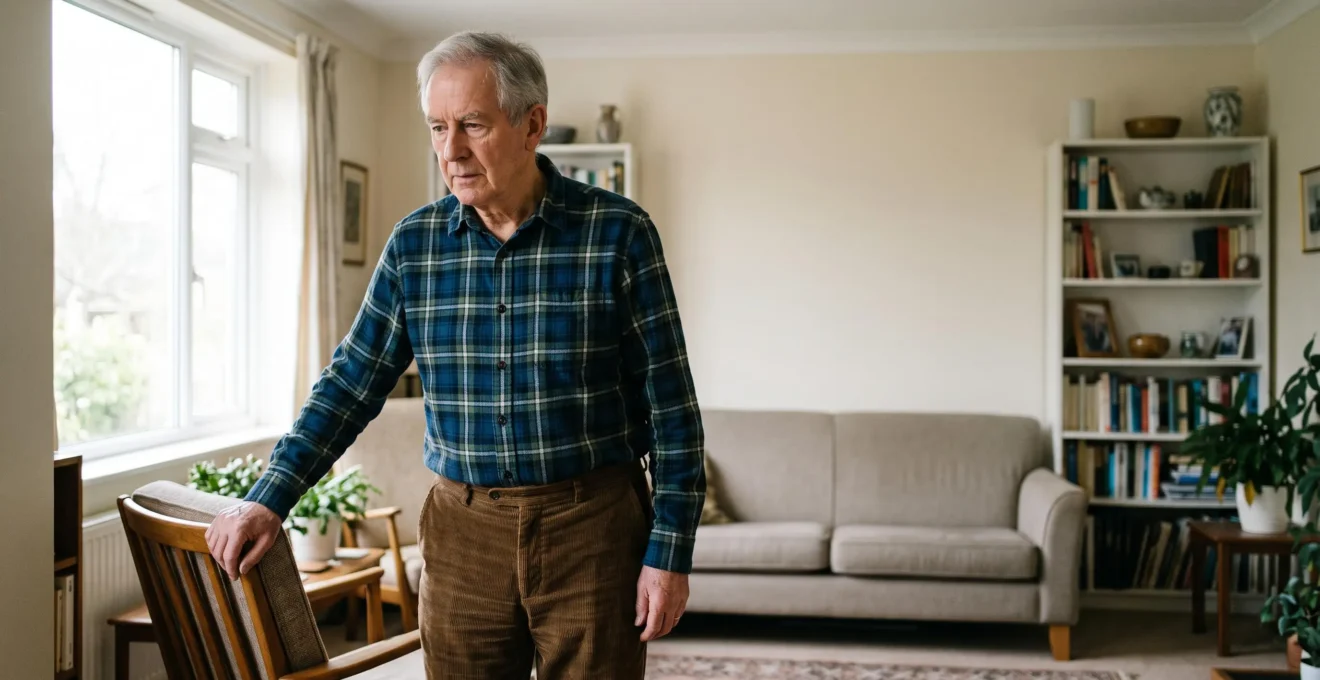
In summary:
- Standing still isn’t passive; it’s an active brain task that relies on a “Sensory GPS” (eyes, inner ear, body feedback).
- This system degrades with age, making standing harder than walking, which uses momentum to help.
- Specific, 5-minute daily exercises can retrain this system, significantly improving your stability.
- Knowing the difference between normal age-related unsteadiness and red flags for your GP is crucial for safety.
You’ve likely noticed it yourself. You can walk to the shops, navigate a busy pavement, and feel reasonably steady. But then you stop to chat with a neighbour, and a subtle, unsettling wobble begins. Suddenly, standing perfectly still feels more precarious than moving. This paradox isn’t in your imagination; it’s a real phenomenon rooted in the complex science of how your body stays upright. While common advice focuses on leg strength or simply “being careful,” these approaches miss the fundamental issue.
The problem isn’t just about muscle. It’s about data. Your ability to stand is managed by a sophisticated, automatic navigation system—a ‘Sensory GPS’—that constantly processes information from your eyes, your inner ear (vestibular system), and the nerves in your joints and feet (proprioception). As we age, the quality of this data feed can degrade, and the brain’s ability to process it slows down. Walking can mask these deficits through momentum and rhythmic muscle patterns, but standing still—a state of active, quiet control—brutally exposes them.
But if the problem is a degradation of the system, the solution is to retrain it. The key isn’t just to build bigger muscles, but to re-calibrate this internal GPS. This article will guide you through the science of why this happens and provide an expert-led, practical framework for rebuilding your stability from the ground up. We will explore the three pillars of balance, learn a progressive 4-week exercise plan, compare the most effective modalities like Tai Chi and Yoga, and clarify which symptoms are a normal part of aging versus which warrant a visit to your GP. It’s time to move beyond the fear of stillness and actively reclaim your stability.
This guide breaks down the science and provides actionable steps to rebuild your stability. Explore the sections below to understand the root cause of the issue and discover how to regain confidence in your balance.
Summary: Why Standing Still Becomes Harder Than Walking After 70?
- What Actually Keeps You Upright and Why Does This System Deteriorate After 65?
- How to Improve Your Standing Balance in 4 Weeks With 5 Minutes of Daily Practice?
- Tai Chi, Yoga, or Balance Boards: Which Actually Improves Postural Control Most After 65?
- Which Balance Problems Are Normal Ageing and Which Signal Conditions Your GP Should Check?
- How to Notice and Correct Your Posture Throughout the Day Before Problems Develop?
- What Is “Core Stability” Really and Why Does It Matter More at 70 Than a Flat Stomach?
- How to Fall-Proof Your Home Without Making It Look Like a Hospital Ward?
- Why a Simple Fall at 70 Can Mean 6 Months of Lost Independence?
What Actually Keeps You Upright and Why Does This System Deteriorate After 65?
Standing still is a marvel of biological engineering, an active process managed by three silent partners: your visual system (what you see), your vestibular system (the fluid-filled canals in your inner ear that detect head movements), and your proprioceptive system (the nerves in your skin, muscles, and joints that report your body’s position in space). Together, they form your “Sensory GPS,” feeding constant, real-time data to your brain, which then makes micro-adjustments in your muscles to keep you centered. This constant, subtle correction is known as postural sway.
After 65, the efficiency of this system begins to decline. It’s not a sudden failure, but a gradual degradation across all channels. Your vision may become less sharp, the sensitive hair cells in your inner ear can diminish, and the nerve signals from your feet may become fainter. The result? The data reaching your brain is noisier and less reliable. A large-scale postural balance study involving nearly 8,000 adults found that this decline accelerates with age, making the task of standing still more demanding.
It’s not just the quality of the data, but the brain’s ability to interpret it. Research from the MOBILIZE Boston Study highlighted a crucial concept: sway complexity. It’s not about swaying less, but about the *quality* and adaptability of your sway. Healthy individuals have a complex, chaotic sway pattern, showing a brain that is constantly exploring and adjusting. A four-year study revealed that older adults with a simpler, more rigid sway pattern had a higher rate of future falls. This reduced complexity was directly linked to deficits in sensory input from the feet and eyes, confirming that a breakdown in the Sensory GPS is a key predictor of instability.
How to Improve Your Standing Balance in 4 Weeks With 5 Minutes of Daily Practice?
Re-calibrating your Sensory GPS doesn’t require hours at the gym. It requires consistent, focused practice that challenges the specific systems that have weakened. The goal is to provide your brain with clear, high-quality signals to improve its control. Based on expert protocols, like those from Johns Hopkins, you can make significant progress with just five minutes a day. The key is safety and progression. Always perform these exercises near a sturdy support like a kitchen counter or in a corner.
The following progressive protocol is designed to be completed over four weeks. Start with Step 1 and only move to the next when you can hold the position steadily for the full 30 seconds with minimal support.
- Week 1: Wide Stance Hold. Stand with your feet shoulder-width apart, eyes open. Hold this position for 10 seconds, gradually working up to 30 seconds. Focus on feeling the ground with your entire foot. If you are stable, try closing your eyes for a few seconds to challenge your vestibular and proprioceptive systems more directly.
- Week 2: Narrow Stance Hold. Bring your feet closer together until they are almost touching. This reduces your base of support and forces your Sensory GPS to work harder. Again, start with 10 seconds and build to 30.
- Week 3: Tandem Stance. Place one foot directly in front of the other, heel to toe, as if on a tightrope. This dramatically challenges your side-to-side stability. Hold for 15 seconds on each side, building up as you feel more confident.
- Week 4: Single-Leg Stance. This is the ultimate test of static balance. Standing on one leg, aim to hold for 10 seconds, then switch sides. Use your support as needed, aiming to touch it less and less over time.
To specifically awaken the nerves in your feet, simple exercises can make a huge difference. This visual shows an exercise that directly stimulates those crucial proprioceptive nerves.
An excellent daily practice is to simply stand barefoot and try to “grip” the floor with your toes, or practice picking up a small towel with your toes. These small movements send a powerful signal to the brain, reminding it of the rich sensory information available from your feet. Always consult your doctor or a physical therapist before starting a new exercise program, especially if you have known balance issues.
Tai Chi, Yoga, or Balance Boards: Which Actually Improves Postural Control Most After 65?
Once you’ve established a baseline with daily standing exercises, you might wonder which formal practice offers the most benefit. While any safe movement is beneficial, Tai Chi, Yoga, and Balance Boards each train the Sensory GPS in a unique way. The “best” choice depends entirely on which part of your balance system needs the most work and what you’ll enjoy enough to do consistently.
For a direct, evidence-based impact on fall prevention, Tai Chi stands out. Its slow, deliberate, weight-shifting movements are a masterclass in proprioceptive retraining. It teaches your brain to feel and control your center of gravity as it moves. A meta-analysis of 24 randomized controlled trials found that Tai Chi effectively reduces the risk of falls in older adults by 24%. The effectiveness grows with the duration and frequency of practice, highlighting the benefit of this mindful, low-impact discipline.
To make an informed choice, it’s helpful to see how these modalities target different aspects of your balance system. The following table breaks down their primary functions. As a randomized controlled meta-analysis found, Tai Chi offers significant, well-rounded improvements.
| Modality | Primary Balance System Trained | Best Suited For |
|---|---|---|
| Tai Chi | Proprioceptive retraining via slow, deliberate weight shifting | Those who enjoy social, mindful, low-impact movement |
| Chair / Gentle Yoga | Core and isometric strength, breath-linked stability | Those with significant fear of falling or instability |
| Balance Board (with support) | Rapid, reactive neuromuscular responses | Already-active individuals seeking an added challenge |
Chair or Gentle Yoga is an excellent starting point, especially for those with significant instability. It builds foundational core strength and flexibility in a safe, supported environment. A Balance Board, used with support, is more advanced. It trains rapid, reactive neuromuscular responses—the kind you need to catch yourself from a trip. It’s a great tool for already-active individuals wanting to sharpen their reflexes. Ultimately, the most effective modality is the one you stick with.
Which Balance Problems Are Normal Ageing and Which Signal Conditions Your GP Should Check?
It’s essential to distinguish between the normal, gradual slowing of your balance systems and “red flag” symptoms that could indicate an underlying medical condition. Understanding this difference empowers you to seek help when it’s truly needed, avoiding both unnecessary anxiety and dangerous delays.
Normal age-related changes are subtle and progressive. They might include:
- Taking a slightly wider stance when standing or walking.
- Slower reaction times, meaning you might take an extra step to regain balance after a stumble.
- Feeling less confident on uneven surfaces like a grassy lawn or a gravel path.
- A general feeling of being slightly less steady than you were a decade ago.
These are signs of your Sensory GPS becoming less efficient, and they can be significantly improved with the exercises discussed in this guide.
However, some symptoms are not a normal part of aging and require a prompt consultation with your GP. These “red flags” include:
- Vertigo: A sensation that you or the room is spinning. This often points to a problem with the vestibular system.
- Sudden, severe dizziness or lightheadedness, especially if accompanied by other symptoms like chest pain, blurred vision, or numbness.
- A feeling of being pushed or pulled, or falling without warning (a “drop attack”).
- Frequent falls, or a sudden increase in the number of stumbles or near-falls.
- A new difficulty with walking, such as shuffling, foot-dragging, or one-sided weakness.
These can be symptoms of conditions ranging from benign paroxysmal positional vertigo (BPPV) and inner ear infections to more serious cardiovascular or neurological issues. Critically, many balance problems are side effects of medication. A thorough medication review with your GP or pharmacist is one of the most important first steps you can take.
How to Notice and Correct Your Posture Throughout the Day Before Problems Develop?
Maintaining good posture isn’t about rigidly holding one “perfect” position. It’s about maintaining your body’s alignment against gravity with minimal effort. As we age, our ability to do this on autopilot diminishes, especially when we are distracted. A controlled study comparing young and older adults found that cognitive tasks significantly increased postural sway in older participants. This shows that we can no longer rely on our automatic systems; we must bring conscious awareness back to our posture.
The key is not constant vigilance, which is exhausting, but creating “postural check-in” triggers throughout your day. The goal is to build a new habit of brief, mindful adjustments. Instead of slouching at the kitchen counter while waiting for the kettle to boil, use those 90 seconds as a posture reset. Stand tall, align your ears over your shoulders, shoulders over hips, and hips over ankles. Feel your weight distributed evenly on both feet.
This conscious monitoring can be turned into a simple, repeatable audit. By linking these checks to existing daily routines, you build a powerful new habit without adding a major task to your day. This proactive approach can prevent the gradual creep of poor posture that exacerbates balance issues over time. Use the following plan to integrate these checks seamlessly.
Action plan: Your daily posture audit
- Identify Triggers: List 3-5 daily activities where you are typically waiting or stationary (e.g., waiting for toast, during TV commercials, standing in a queue). These are your new posture check-in points.
- The “String” Check: At each trigger point, imagine a string pulling you up from the crown of your head. Let your shoulders relax down and back. Tuck your chin slightly.
- Weight Distribution Scan: Notice where your weight is. Is it on your heels? Your toes? One leg more than the other? Consciously shift your weight until it feels evenly distributed across both feet.
- Breathing Anchor: Take one deep, slow breath. Feel your rib cage expand 360 degrees, not just in your chest. This helps engage your deep core muscles, the foundation of your posture.
- Correct and Release: Hold the corrected posture for the duration of the wait, then consciously release. The goal is not to be rigid, but to remind your body where “neutral” is.
What Is “Core Stability” Really and Why Does It Matter More at 70 Than a Flat Stomach?
The term “core stability” has been co-opted by the fitness industry to mean visible, six-pack abdominal muscles. For postural control after 70, this definition is not only unhelpful, it’s misleading. True core stability isn’t about the superficial muscles you see; it’s about the deep, internal corset of muscles you can’t see.
Think of your core as a 3D cylinder. The diaphragm is the lid, the pelvic floor is the base, and the walls are formed by the transversus abdominis (the deepest abdominal layer that wraps around you like a corset) and the multifidus muscles (tiny muscles running along your spine). When these muscles work together in harmony, they create intra-abdominal pressure that stabilizes your spine from the inside out. This isn’t about brute strength; it’s about endurance and coordinated, reflexive activation.
At 70, this system matters more than ever for two reasons. First, it provides a stable base for movement. When you lift your arm or leg, your deep core should fire a fraction of a second *before* the limb moves, creating a solid platform. If the core is weak, your body has to create stability elsewhere, leading to compensation patterns, strain, and instability. Second, these muscles are your first responders to a loss of balance. When you stumble, a strong, reactive core can instantly stiffen your torso, giving you the critical moment needed to move your feet and prevent a fall. A weak core results in a “floppy” torso, making a fall far more likely.
Forget crunches, which only work the superficial “six-pack” muscle. Focus on exercises that train this deep, stabilizing cylinder. Practices like Pilates, specific physical therapy exercises, and even conscious, deep “360-degree” breathing can retrain these crucial muscles. It’s not about achieving a flat stomach; it’s about building a responsive, resilient center that can protect you from instability and falls.
How to Fall-Proof Your Home Without Making It Look Like a Hospital Ward?
The advice to “fall-proof your home” often conjures images of cold, clinical grab bars and stark, empty rooms. This doesn’t have to be the case. The goal is to make your environment safer by reducing hazards and adding support, but this can be done with style and subtlety. The best safety modifications are the ones that blend seamlessly into your home’s decor, enhancing its comfort and usability, not detracting from it.
Think “integration” not “installation.” Instead of seeing your home as a series of risks to be eliminated, view it as a space to be optimized for ease of movement. The key is to address the three main risk areas: lighting, flooring, and transitions.
- Lighting: Poor lighting is a primary cause of trips and falls, especially at night. The solution isn’t just brighter bulbs. Install motion-sensor night lights in hallways, bedrooms, and bathrooms. Use “smart” plugs or bulbs to schedule lamps to turn on before dusk. Ensure light switches are at the entry and exit of every room, including long hallways.
- Flooring: The “remove all rugs” advice is often impractical and makes a home feel cold. Instead, make your rugs safe. Use high-quality, non-slip underpads for all area rugs. Ensure rug edges are flat and not curled. If you have hard floors, choose low-pile rugs over deep-shag ones to reduce the trip hazard. Address any uneven floorboards or transitions between rooms.
- Transitions and Support: This is where aesthetics are key. Instead of a clinical grab bar in the bathroom, consider a stylish, modern towel rack that is professionally rated and installed for support. In a long hallway, a sturdy, decorative chair rail can provide a handhold without looking medical. The most important step is decluttering. Clear pathways are non-negotiable. View decluttering not as a chore, but as a design choice towards a more minimalist, serene, and safe environment.
Ultimately, a safe home is a comfortable and well-organized home. By focusing on smart lighting, secure flooring, and integrated supports, you can drastically reduce your fall risk without sacrificing the warmth and personality of your living space.
Key takeaways
- Your balance is not just muscle; it’s a “Sensory GPS” skill involving your eyes, inner ear, and body feedback that can be retrained.
- Significant improvements in stability can be achieved with specific, progressive exercises performed for just 5 minutes daily.
- Simple, stylish home modifications to lighting, flooring, and support can drastically reduce fall risk without making your home feel like a clinic.
Why a Simple Fall at 70 Can Mean 6 Months of Lost Independence?
It is easy to dismiss a minor stumble or a “small fall” as insignificant. But for an older adult, the consequences can spiral far beyond a bruise or a moment of embarrassment. A single fall can act as a trigger for a cascade of events that can lead to a significant, and sometimes permanent, loss of independence. Understanding the stark reality of this risk is the single most powerful motivator for taking proactive steps to improve your balance.
The statistics are sobering. According to national safety data, in 2024, 43,020 individuals aged 65 and older died as a result of preventable falls. In 2023, over 3.85 million were treated in emergency departments for fall-related injuries. The physical injury—a hip fracture, a broken wrist, a head injury—is just the first domino to fall. It often leads to hospitalization, a period of immobility, and subsequent muscle loss (atrophy). This physical deconditioning makes the body weaker and even more prone to another fall, creating a vicious cycle.
Beyond the physical is the psychological impact. A fall can shatter confidence, creating a potent “fear of falling.” This fear often leads individuals to limit their activities, stay home more, and become less physically active. This self-imposed isolation not only accelerates physical decline but can also lead to depression and social withdrawal. As Dr. Jennifer L. Vincenzo, a physical therapy researcher, noted, the situation is urgent and not fully understood:
Unfortunately, fall-related deaths are increasing and we’re not sure why that is.
– Dr. Jennifer L. Vincenzo, Journalist’s Resource
This is why every small effort to improve your balance, every daily exercise, and every home modification is a profound investment in your future. It’s not about preventing a fall; it’s about preserving your ability to live an active, engaged, and independent life on your own terms. The first step to regaining control is understanding the problem. Start today by choosing one simple exercise from this guide and scheduling a conversation with your GP about your balance.
Frequently Asked Questions about Why Does Standing Still Become Harder Than Walking After 70?
Is feeling less steady after 65 always a medical problem?
Not necessarily. Mild unsteadiness is a common part of aging. However, it becomes a concern when it triggers a fear of falling that limits your daily life. Among seniors who have had a recent fall, up to 70% report this fear, and half of them may reduce their physical or social activities as a result. This cycle of fear and inactivity ironically increases the risk of future falls, making it a problem that needs to be addressed through confidence-building exercises and, if necessary, medical review.
What is the single most overlooked cause of balance problems?
Medications. Many common prescription and over-the-counter drugs can cause dizziness, drowsiness, or postural hypotension (a drop in blood pressure on standing) as a side effect. Public health guidance emphasizes that any fall risk reduction plan must include screening for medications that can increase fall risk. A comprehensive medication review with your doctor or a pharmacist is a critical, and often neglected, first step in diagnosing and resolving balance issues.
What other factors increase fall risk beyond balance itself?
Nutritional deficiencies play a significant role. A low body mass index, often resulting from poor nutrition, is associated with an increased risk of falls. Specifically, vitamin D deficiency is a major culprit. It can lead to muscle weakness (myopathy), contribute to osteoporosis (brittle bones), and impair gait patterns, all of which directly increase the likelihood of falling and the severity of an injury. Your GP can easily screen for vitamin D levels and other nutritional deficiencies.