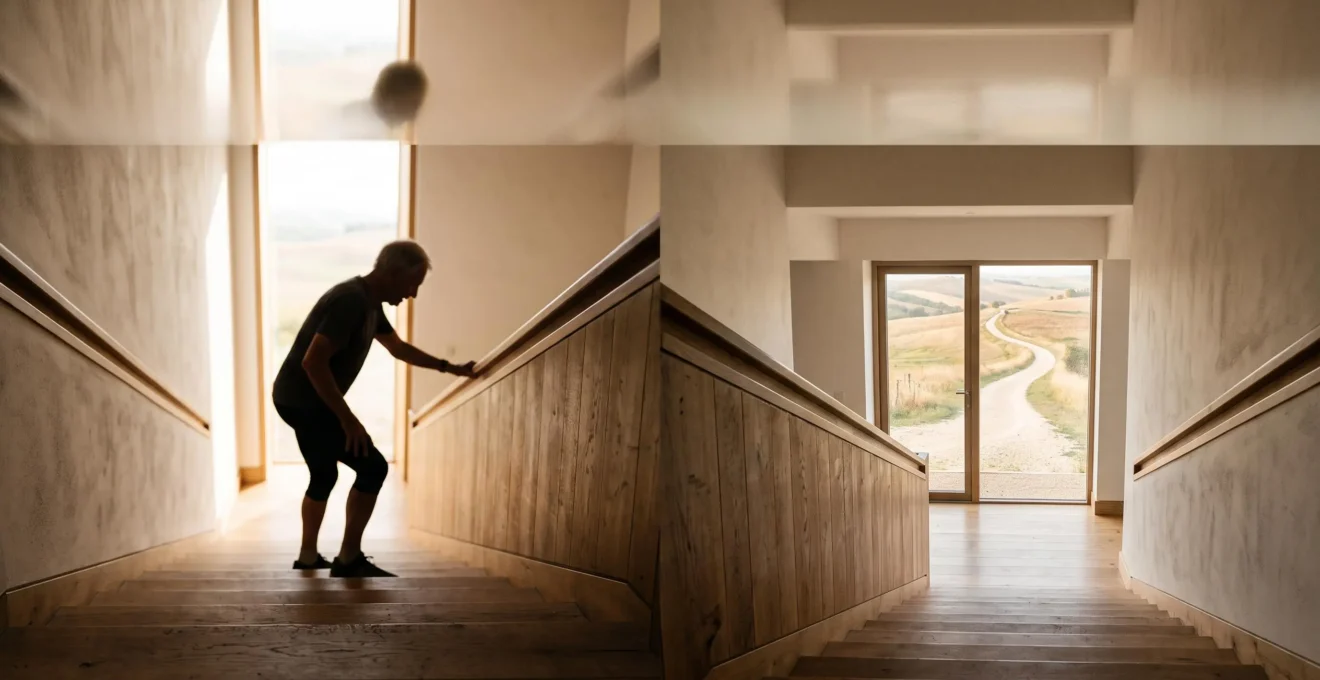
The breathlessness you feel on the stairs is less about your age and more about reversible ‘deconditioning’—and you have significant power to change it.
- A large portion of lost stamina often blamed on ageing is actually due to inactivity, a cycle you can break.
- Simple, consistent “fitness snacks” like a few daily stair climbs can measurably improve your cardiovascular health without demanding gruelling workouts.
Recommendation: Instead of accepting breathlessness as inevitable, view it as a signal to start rebuilding your fitness, one small, manageable step at a time.
That familiar feeling of reaching the top of the stairs, heart pounding, needing a moment to catch your breath. It’s a common experience for many at 60, 70, and beyond. The immediate, almost automatic thought is often, “Well, I’m not as young as I used to be.” It’s easy to chalk it up to the simple, unavoidable process of ageing. We see fitness as a finite resource that naturally depletes with each passing decade, a stark contrast to the seemingly boundless energy we had at 40.
But what if that common assumption is only a small part of the story? What if a significant portion of that lost stamina isn’t an irreversible consequence of your birth certificate, but rather the result of a process called deconditioning? This is the crucial distinction that often gets missed. Ageing involves some inevitable physiological changes, yes, but deconditioning is the body’s adaptive response to a lack of physical challenge. The good news is that while you can’t reverse your chronological age, you can absolutely reverse deconditioning.
This article will shift your perspective from one of passive acceptance to one of active empowerment. We will explore the real science behind why your body responds differently to activity at 70, how to differentiate what’s truly age-related from what you can reclaim, and provide practical, joint-friendly strategies to rebuild your endurance. This isn’t about training for a marathon; it’s about making the stairs, the walk to the shops, and playing with grandchildren feel easy again. It’s about lowering your ‘vascular age’ and proving that it’s never too late to feel strong and capable.
In the following sections, we will break down this journey into manageable parts. From understanding the changes in your body to implementing safe and effective exercises, this guide provides a complete roadmap to reclaiming the stamina you thought was lost for good.
Summary: Why Breathlessness at 70 Is a Reversible Challenge, Not a Life Sentence
- How Much of Your Lost Stamina Is Ageing and How Much Is Deconditioning You Can Reverse?
- How to Build Stamina at 65 When Walking to the Shops Leaves You Breathless?
- Walking, Cycling, or Swimming: Which Builds Endurance Best While Protecting Ageing Joints?
- What Actually Changes in Your Heart and Arteries Between 50 and 70?
- What Happens in Your Body at 70 When You Start Moving That Didn’t Happen at 40?
- Why Does Moving Regularly Matter More at 70 Than at 40 Even If You Weren’t Active Before?
- How Hard Should Cardio Feel at 70: The “Talk Test” and Other Intensity Guides?
- How to Keep Your Improved Fitness Once You’ve Built It Without Constant Hard Training?
How Much of Your Lost Stamina Is Ageing and How Much Is Deconditioning You Can Reverse?
The most empowering truth in modern fitness science for older adults is the distinction between ageing and deconditioning. While it’s true that our bodies change, the decline many people experience is not a one-way street. In fact, research suggests that as much as 50-70% of this decline in aerobic capacity is due to inactivity, not the ageing process itself. This is deconditioning: the body adapting downwards to a lack of physical stimuli. When we avoid the stairs because they make us breathless, our body’s capacity to climb them diminishes further, creating a self-fulfilling prophecy.
Ageing does bring some non-negotiable changes. Maximum heart rate tends to decrease, and arteries can lose some elasticity. However, these factors account for a much smaller portion of lost stamina than most people assume. The lion’s share comes from reversible factors: reduced muscle mass, decreased efficiency of oxygen use by the muscles, and a less responsive cardiovascular system—all direct results of a sedentary lifestyle.
The Downward Spiral of Avoidance
A landmark longitudinal study in the journal Circulation provided a clear mechanism for this. It found that the perceived effort of an activity is relative to a person’s peak oxygen uptake (VO2 max). As deconditioning lowers your VO2 max, even simple activities like climbing stairs take up a larger percentage of your maximum capacity, making them feel harder and causing more breathlessness. This feeling then encourages further avoidance, which in turn accelerates the decline in aerobic capacity. It’s not age causing the spiral; it’s the avoidance of activity that powers it.
This means the power to change the narrative is largely in your hands. By reintroducing regular physical challenges, you can directly combat deconditioning, improve your heart’s efficiency, and increase your muscles’ ability to use oxygen. The first step is to understand your personal baseline.
Your Personal Stamina Audit: 4 Steps to a Baseline
- The Chair-Stand Test: Use a standard dining chair. Sit in the middle and cross your arms over your chest. Time yourself for 30 seconds and count how many times you can stand up completely and sit back down. This measures lower body strength and endurance.
- The 400-Meter Walk: On a track or measured path, time how long it takes you to walk 400 meters (about a quarter mile) at a comfortable, natural pace. This is a classic test of aerobic endurance.
- The Stair-Climb Test: Find a flight of stairs (10-12 steps). Time how long it takes you to ascend at a safe, steady pace. This is a practical test of functional strength and power.
- Record and Repeat: Write down your numbers for all three tests today. This is your personal baseline, not a competition. Repeat the same three tests in 8 weeks to see tangible, motivating proof of your progress.
How to Build Stamina at 65 When Walking to the Shops Leaves You Breathless?
The thought of starting an exercise program when you’re already feeling breathless can be daunting. The secret is to reframe your idea of “exercise.” You don’t need a gym membership or an hour-long commitment. The most effective approach is to start small—incredibly small—with a concept called “fitness snacking.” This involves scattering short bursts of activity, or “snacks,” throughout your day. Instead of one big, intimidating “meal” of exercise, you have several small, manageable bites. This approach not only feels more achievable but is also scientifically proven to be effective.
For example, instead of seeing a flight of stairs as a single, unconquerable obstacle, view it as three separate opportunities. Climb one flight in the morning, another after lunch, and a third in the evening. Each climb is a fitness snack. Research has shown that this type of activity makes a real difference. A controlled home-based stair-climbing study found that even this simple approach resulted in a VO2max improvement of +1.63 mL/min/kg in previously sedentary adults—a measurable increase in aerobic fitness.
The goal is to gradually increase the duration or frequency of these snacks. Start with just two minutes of movement. Add a short, brisk walk to the end of your driveway and back. The next week, maybe walk to the end of the block. The key is consistency over intensity. Small steps, repeated daily, accumulate into significant results over time. It’s always wise to get a green light from your doctor or a physical therapist before starting, but the principle remains: start where you are, use what you have, and do what you can.
Each small effort is a deposit into your fitness bank account. The initial goal isn’t to run a race; it’s simply to make tomorrow’s walk to the shops feel a little bit easier than today’s. That is the true meaning of progress.
Walking, Cycling, or Swimming: Which Builds Endurance Best While Protecting Ageing Joints?
Once you’ve built some initial confidence with fitness snacking, the natural next question is: what kind of activity is best? For older adults, the ideal exercise builds cardiovascular endurance while minimizing stress on the joints. Walking, cycling (especially on a stationary or recumbent bike), and swimming are the three gold-standard, low-impact options. But the optimal strategy isn’t to choose one; it’s to combine them.
Each activity offers a unique benefit, and rotating them prevents overuse injuries and works the body in different ways. Think of it as creating a balanced fitness diet:
- Walking: This is a weight-bearing exercise, which is crucial for maintaining bone density. Using a treadmill or walking on a safe, even path is an accessible way to load the bones and strengthen the heart. It’s the foundational element of a senior fitness routine.
- Cycling/Elliptical: These activities provide excellent cardiovascular benefits with virtually no impact. A recumbent bike offers back support, making it even more comfortable. These are perfect for days when your joints feel a bit stiff, allowing you to get your heart rate up without the pounding of pavement.
- Swimming/Water Aerobics: Water provides a unique combination of buoyancy and resistance. It supports your body weight, making it completely non-impactful and ideal for those with arthritis or joint pain. At the same time, moving through the water provides resistance that strengthens muscles and improves lung capacity.
The smartest approach is to create a weekly schedule that incorporates at least two of these activities. For example, you might walk on Monday, Wednesday, and Friday for bone health, and use a stationary bike or go for a swim on Tuesday and Thursday for joint-friendly cardio. This method, known as cross-training, not only keeps your body guessing but also prevents the mental boredom that can come from doing the same thing every day. It ensures you’re building a robust, resilient fitness that protects your joints for the long haul.
What Actually Changes in Your Heart and Arteries Between 50 and 70?
To truly understand why fitness matters more as we age, we need to look inside the engine room: the heart and arteries. There are indeed some structural changes that are a normal part of the ageing process. Between the ages of 50 and 70, the walls of the major arteries, like the aorta, tend to become thicker and stiffer. Postmortem studies have shown that the aortic diameter increases by 15-20% between the ages of 20 and 80. This stiffening means the heart has to work harder to pump blood through the system, a change known as increased arterial stiffness.
This is where the powerful concept of “vascular age” comes in. While your chronological age is fixed, your vascular age—the functional age of your arteries—is not. It can be significantly influenced by lifestyle, particularly exercise. Regular aerobic activity has been proven to combat and even reverse some of this age-related arterial stiffening, effectively making your arteries “younger” and more flexible.
This image provides a powerful visual metaphor. On one side, you have a flexible, compliant tube, representing a healthy, “young” artery. On the other, a rigid, cracked surface, symbolizing a stiff, aged artery. Exercise is the tool that helps maintain the characteristics on the left, regardless of the date on your birth certificate.
The EXAMIN AGE Trial: Proving Vascular Age is Trainable
The EXAMIN AGE trial provided direct evidence for this concept. By measuring pulse wave velocity (a direct measure of arterial stiffness) in over 140 older adults, researchers found a clear link. Higher cardiorespiratory fitness was strongly associated with lower arterial stiffness. In fact, an individual’s VO2 max (a key marker of fitness) explained 18% of the variance in their arterial stiffness. This directly supports the idea that by training your fitness, you are actively training your arteries to remain more youthful and efficient.
What Happens in Your Body at 70 When You Start Moving That Didn’t Happen at 40?
When you start a new activity program at 70, your body responds with the same fundamental principles as it did at 40, but the starting point and the impact are profoundly different. At a cellular level, regular exercise signals your body to increase the density of mitochondria—the tiny “power plants” within your muscle cells that convert oxygen and fuel into energy. A period of inactivity causes a surprisingly rapid decline in their numbers. After just two months of inactivity, mitochondrial density can fall significantly. This is a primary reason why getting back into activity feels so hard; your muscles literally have less machinery to produce energy.
However, the magic is that this process is entirely reversible, and the response to training is robust at any age. As you begin to move consistently, even with gentle activities, you send a powerful signal to your body to build more mitochondria. This is perhaps the most significant thing happening under the surface: you are rebuilding your cellular energy production system from the ground up.
VO2 max responds well to training at any age.
– Stress Free Longevity, VO2 Max by Age: What Your Number Means and Why it Matters
At 70, the stakes are higher, and the relative gains can feel even more impactful. At 40, you might have been exercising to improve performance—to run a faster 5K or lift a heavier weight. At 70, you are often exercising to reclaim function—to carry groceries without getting winded or to play on the floor with your grandchildren. The psychological and functional reward of seeing your body adapt and grow stronger at this stage of life is immense. You’re not just getting fitter; you are actively pushing back against frailty and preserving your independence.
Why Does Moving Regularly Matter More at 70 Than at 40 Even If You Weren’t Active Before?
While staying active is beneficial at any age, its importance magnifies significantly in your later years. At 40, you likely had a larger “physiological reserve.” Your muscle mass, bone density, and cardiovascular capacity were naturally higher, providing a buffer against periods of inactivity. A few weeks off might have made you feel a bit out of shape, but it rarely threatened your fundamental ability to perform daily tasks. At 70, that reserve is smaller. Consequently, inactivity doesn’t just mean a loss of fitness; it can mean a loss of function.
This is where the concept of the “vicious cycle” becomes critically important. As experts note, avoiding physical activity due to breathlessness or effort leads to a further reduction in aerobic capacity. This makes subsequent activity even harder, which encourages more avoidance. It’s a downward spiral that can accelerate rapidly.
The Link Between Aerobic Capacity and Frailty
The connection is not just theoretical; it’s directly tied to clinical outcomes. A longitudinal study on healthy older adults published in Circulation discovered a sobering link. They found that an accelerated loss of aerobic capacity is directly connected to low levels of physical activity, slow walking speeds, and early exhaustion. These are three of the five clinical criteria used to define frailty, a state of increased vulnerability to adverse health outcomes. Therefore, the breathlessness you feel on the stairs isn’t just an inconvenience; it can be an early warning sign on the path toward frailty.
This is why moving at 70 matters more. Each walk, each stair climb, each swim is an act of rebellion against this cycle. It’s not just about “staying in shape”; it’s about actively preserving your independence, your mobility, and your quality of life. At 40, exercise was an option. At 70, it becomes an essential tool for maintaining the life you want to live.
Key Takeaways
- Much of the stamina loss blamed on “ageing” is actually reversible “deconditioning” from inactivity.
- Start with “fitness snacks”—short, frequent bursts of activity—to rebuild your base without feeling overwhelmed.
- Maintaining fitness requires significantly less work than building it, with as few as two sessions a week being effective.
How Hard Should Cardio Feel at 70: The “Talk Test” and Other Intensity Guides?
Once you start moving, it’s important to know how hard to push. Too little, and you won’t stimulate change; too much, and you risk injury or burnout. Forget complicated heart rate formulas, which can be unreliable for older adults, especially those on certain medications. The two best tools are simple, intuitive, and approved by experts: the Talk Test and the Rate of Perceived Exertion (RPE) scale.
The Talk Test is brilliantly simple. During activity, your intensity level should allow you to hold a conversation. If you can sing, you’re likely in a light intensity zone. If you can talk comfortably in full sentences, you’re in the moderate zone—the sweet spot for most endurance-building cardio. If you can only manage a few words at a time, you’re in the vigorous zone, which should be approached with caution and for shorter periods. If you can’t talk at all, you’re pushing too hard and should ease off.
The Borg RPE Scale is a more structured way to quantify this feeling. It runs from 6 (no exertion at all) to 20 (maximal exertion). For steady-state cardio, the target for older adults is typically in the 12-14 range, which corresponds to “moderate” effort. This scale is so reliable that it’s formally endorsed by leading medical bodies, and it’s especially crucial for certain populations.
Cardiac patients on beta-blockers show unreliable heart rate responses, so RPE-guided exercise (typically RPE 11-13) ensures safe intensity.
– Pabau Clinical Team, Borg RPE Scale: Complete Guide and Free Template
Using these tools empowers you to become the expert on your own body. The table below shows how the RPE scale maps directly to the Talk Test, giving you a clear guide for every workout. This approach, endorsed by organizations like the American College of Sports Medicine, ensures your exercise is both safe and effective.
| RPE (Borg 6-20) | Perceived Effort | Talk Test |
|---|---|---|
| 6-8 | No exertion / Very light | Can sing comfortably |
| 9-11 | Very light to light | Can talk and sing easily |
| 12-14 | Moderate (target for most cardio) | Can talk, but not sing |
| 15-17 | Vigorous | Can only speak short phrases |
| 18-20 | Maximal | Cannot talk |
How to Keep Your Improved Fitness Once You’ve Built It Without Constant Hard Training?
After weeks of consistent effort, you’ve done it. The stairs feel easier, the walk to the shops is a pleasure, and you feel more energetic. The next question is a big one: do I have to keep working this hard forever? The answer, thankfully, is a resounding no. One of the most motivating principles of exercise science is that maintaining fitness requires far less work than building it. This is the concept of the “minimum effective dose.”
Once you’ve built your aerobic base, your goal shifts from accumulation to maintenance. Research has shown that you can maintain your strength and cardiovascular gains with a surprisingly small amount of work. For example, a 2021 study found that just two sessions a week are needed to maintain a decent level of fitness. This is particularly relevant for older adults, as consistency trumps volume.
For adults older than 60, there’s a bit of evidence that twice-a-week sessions are better at preserving muscle.
– Alex Hutchinson, What’s the Minimum Dose of Training to Stay Fit?, Outside Online
This principle is also your best friend when life gets in the way. If you have a week where you’re feeling unwell, traveling, or simply too busy, don’t throw in the towel. Instead of an all-or-nothing mindset, shift to a maintenance mindset. Just aim for two shorter, moderate-intensity sessions that week. This is enough to prevent significant deconditioning and makes it infinitely easier to get back to your full routine the following week. This approach transforms a missed workout from a “failure” into a planned “maintenance session,” preserving both your fitness and your motivation.
The journey to fitness isn’t a relentless upward climb. It’s a process of building, then intelligently and efficiently maintaining. Knowing that you can preserve your hard-won gains with just a couple of focused sessions per week is the ultimate key to long-term, sustainable health.
By understanding that breathlessness is a conversation, not a verdict, you’ve already taken the most important step. Now, the journey is about listening to your body, starting small, and celebrating every single flight of stairs that feels just a little bit easier. Your stronger, more energetic future starts not with a leap, but with a single, confident step.