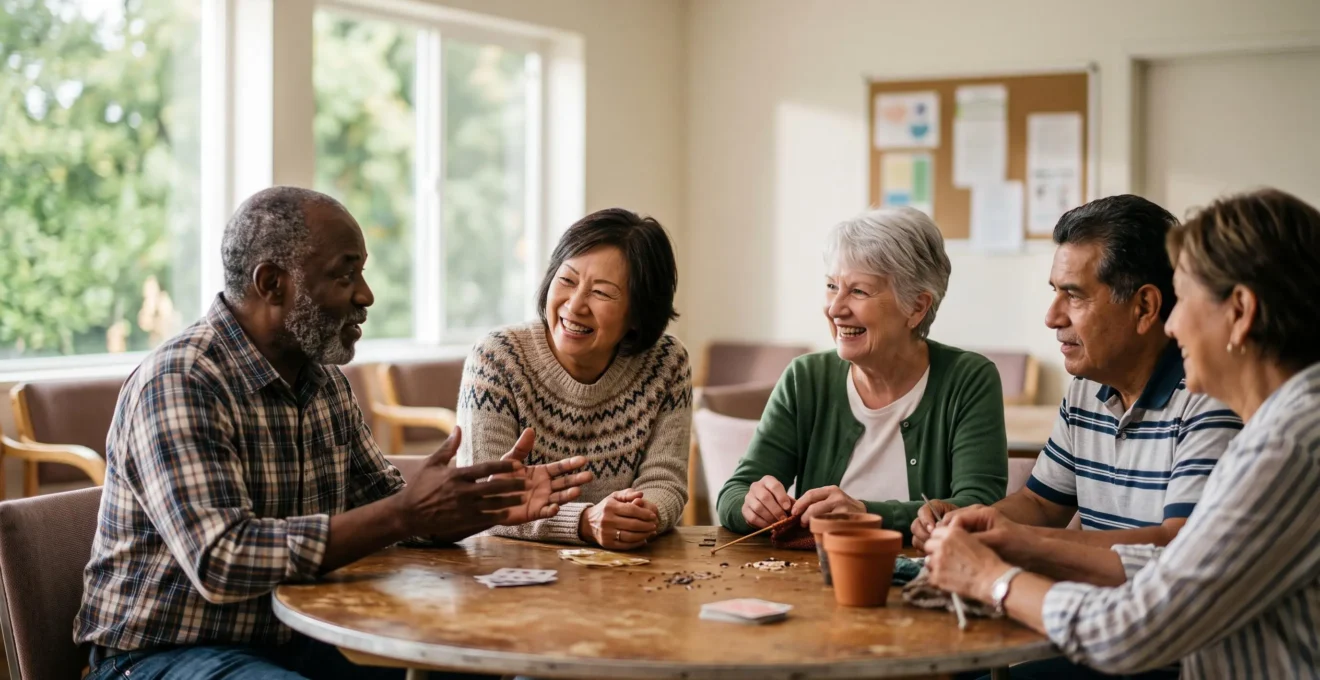
Regularly engaging in a community group is a form of “social prescription” that provides measurable health benefits, often surpassing those of certain medications for age-related conditions.
- Scientific analysis shows strong social relationships decrease the risk of premature mortality as much as quitting smoking.
- Social activity directly builds “cognitive reserve,” measurably lowering the risk of developing dementia and boosting immune function.
Recommendation: Identify one low-pressure local group activity and commit to attending just once, viewing it not as a social test but as a vital, evidence-based step for your long-term health.
The suggestion to “join a club” in retirement can often feel like a well-meaning but trivial piece of advice, filed alongside suggestions to take up knitting or finish a crossword. Many seniors, particularly those who feel isolated or out of practice socially, may view the prospect with apprehension, uncertainty, or even dismissal. The common wisdom is that these activities are merely a way to pass the time, a pleasant distraction from the more serious realities of aging. We are told to focus on diet, exercise, and the prescriptions from our doctors—the “real” pillars of health.
But what if this perspective is fundamentally wrong? What if the simple act of showing up for a weekly book club, a walking group, or a volunteer meeting triggers a cascade of powerful physiological changes? The emerging science of social connection is revealing a profound truth: meaningful group engagement is not just a hobby. It is a biological necessity. This article moves beyond the platitudes to explore the hard evidence. We will dissect the mechanisms by which joining a club at 65 can become one of the most potent health interventions you can make—a “social prescription” with the power to protect your brain, fortify your heart, and measurably extend your lifespan.
This guide provides an evidence-based look at why community engagement is so effective and offers a practical roadmap for overcoming the very real barriers to getting started. We will explore the science, identify the right type of group for your personality, and provide concrete strategies for turning new acquaintances into genuine friends. Prepare to see your local community centre in a new light: as a pharmacy for your well-being.
Table of Contents: The Evidence-Based Case for Joining a Club After 65
- What Does Regular Club Attendance Actually Do for Your Brain, Heart, and Immune System?
- How to Find Clubs That Match Your Interests and Energy Level in Your Local Area?
- Sports Clubs, Interest Groups, or Service Organisations: Which Social Format Suits Your Personality?
- How to Walk Into a Room of Strangers at 70 When You’ve Been Out of Practice for Years?
- How to Move Beyond Acquaintances to Actual Friends When You Join a New Group at 65?
- How Does Having Coffee With Friends Actually Affect Your Heart, Immunity, and Brain?
- How to Create an Exercise Routine at 65 That You Can Still Follow at 85?
- Why Do Socially Connected 75-Year-Olds Live 7 Years Longer Than Their Isolated Peers?
What Does Regular Club Attendance Actually Do for Your Brain, Heart, and Immune System?
The idea that friendship is “good for you” is intuitive, but the scientific reality is far more potent than most realise. Regular social engagement is not a passive benefit; it actively builds resilience at a cellular level. Think of it as a physiological tune-up. When you participate in a club, your brain, heart, and immune system receive a powerful, multi-system boost. For the brain, the effect is profound. Socially stimulating activities build what researchers call “cognitive reserve”—the brain’s ability to withstand neurological damage. In a landmark study, the Rush University Memory and Aging Project found that seniors with the highest levels of social activity had a markedly lower likelihood of developing dementia than their least social peers. They remained dementia-free for years longer, purely as a function of staying engaged.
The benefits extend directly to your cardiovascular and immune systems. Loneliness acts as a chronic stressor, triggering an inflammatory response similar to what occurs during a physical injury. Over time, this chronic inflammation damages blood vessels and impairs immune function. Social connection is the antidote. It lowers stress hormones like cortisol, reducing inflammation and blood pressure. The scale of this effect is astonishing. A landmark meta-analysis of 148 studies, covering over 308,000 people, found that individuals with strong social ties had a 50% increased likelihood of survival, regardless of age, sex, or initial health status. As lead researcher Dr. Julianne Holt-Lunstad noted, the mortality risk associated with a lack of social connection is comparable to that of smoking 15 cigarettes a day and greater than that of obesity or physical inactivity. In short, attending that weekly meeting is a clinically significant health behaviour.
This evidence reframes club attendance from a simple pastime to a non-negotiable component of a healthy aging strategy.
How to Find Clubs That Match Your Interests and Energy Level in Your Local Area?
Knowing that social connection is vital is one thing; finding the right outlet is another. For many seniors, especially the nearly one-quarter of those over 65 who are considered socially isolated, the first step can feel overwhelming. The key is to move away from the pressure of “making friends” and instead focus on “finding interesting activities.” The connection will follow. Start by taking a simple inventory. What did you enjoy doing before work and family life took over? What’s a skill you’ve always wanted to learn? Make two lists: one for low-energy interests (reading, playing cards, watching films) and one for high-energy interests (walking, gardening, dancing).
With this list, you can begin a targeted search. Go beyond the traditional community centre notice board. Many modern resources can help you find your niche.
- Local Libraries and Council Websites: These are often the most up-to-date hubs for registered community groups, from local history societies to public speaking clubs.
- Meetup.com: This online platform allows you to search for groups by interest in your specific geographic area. You can find everything from senior-specific hiking groups to philosophy discussion circles.
- Specialty Stores: A local wool shop will know about knitting circles; a garden centre will be connected to horticultural societies; a bookshop often hosts book clubs.
- Continuing Education Centres: Enrolling in a class (e.g., pottery, a new language) is a fantastic, low-pressure way to meet people with a shared goal.
The goal is to find a setting where the activity itself provides a natural talking point, removing the burden of forced conversation. The Stitch community, a platform designed for older adults, found that its members saw measurable improvements in health simply by having a structured way to find and join such groups, reinforcing what founder Andrew Dowling notes: “Socially connected seniors are more likely to get out and be physically active.”
Choosing the right environment is not about finding the most popular club; it’s about finding the one where you feel most comfortable simply being present.
Sports Clubs, Interest Groups, or Service Organisations: Which Social Format Suits Your Personality?
Once you’ve identified potential interests, the next layer of successful integration is matching the group’s social structure to your personality. Not all clubs are created equal, and the “best” one is highly dependent on your social style. Broadly, groups fall into two categories: those based on “parallel activity” and those based on “direct socialisation.” Understanding this distinction is key to avoiding a mismatch that can lead to discouragement.
Parallel activity clubs are ideal for introverts or those feeling socially rusty. In these groups—like a gardening club, a craft circle, a choir, or a walking group—the main focus is on a shared task. Conversation happens naturally and often in smaller, one-on-one pairings, but it isn’t the central requirement for participation. You can contribute and feel a sense of belonging without the pressure of constant, face-to-face interaction. The shared activity provides a comfortable buffer and an easy topic of conversation when you’re ready. For many, this is the perfect on-ramp to social re-engagement.
Conversely, direct socialisation clubs are built around interaction itself. Examples include book clubs, discussion groups, card-playing leagues (like bridge), or “coffee and chat” meetups. These formats are better suited for extroverts who are energised by conversation and group dynamics. The primary purpose is to talk, debate, and engage directly with others. While highly rewarding for the right personality, they can feel intense for someone who prefers a quieter approach. As a systematic review covering social clubs and community organisations found, consistent participation is linked to better cognitive outcomes, suggesting the act of engaging is critical, regardless of format. The most important thing is to choose the environment where you are most likely to show up consistently.
There is no right or wrong choice; the goal is sustainability. Select the format that lowers the barrier to entry for you personally.
How to Walk Into a Room of Strangers at 70 When You’ve Been Out of Practice for Years?
The biggest hurdle for many is not finding a club, but physically walking through the door for the first time. This anxiety is real, valid, and entirely normal. After years of established routines, the thought of being the “new person” in a room of established friendships can be daunting. The solution lies in shifting your mindset and using a strategy called “behavioural activation.” This psychological principle states that action precedes motivation. You don’t join a club when you feel confident; you join a club to *build* confidence. The feeling of belonging comes *after* the act of showing up, not before.
To make that first step manageable, arm yourself with a practical plan. First, do some reconnaissance. Contact the group leader beforehand. Ask a few simple questions: “I’m new to this, what’s a typical meeting like?” or “Is there anything I should bring?” This initial contact transforms you from a total stranger into “the person who called last week.” Second, give yourself a clear, small, and achievable goal for the first meeting: “My goal is to stay for 20 minutes and learn one person’s name.” That’s it. You are not there to become a permanent member or make a best friend. You are there to observe and complete a tiny mission. This reframes the event from a high-stakes social test into a low-stakes information-gathering exercise.
Finally, focus on the environment itself. Research shows the quality of the space matters. For instance, a recent study of senior centers in Los Angeles found that when attendees perceived the environment as welcoming and well-run, they reported better cognitive health. Look for signs of a well-managed group: a clear agenda, a designated greeter, or name tags. These small structural elements are signs of a group that is used to welcoming new people, which can significantly lower the social barrier for entry.
Remember, every single person in that room was once the new person. Your presence is not an intrusion; it’s the lifeblood of a healthy group.
How to Move Beyond Acquaintances to Actual Friends When You Join a New Group at 65?
Attending a club regularly is the first and most important step. But how do you transition from cheerful hellos over a shared activity to the deeper, more meaningful connections that provide the greatest health benefits? The journey from acquaintance to friend is built on two principles: consistency and vulnerability. Friendship at any age is a function of time and shared experience. Showing up consistently to the same group allows others to see you as a reliable and integrated part of the community. This familiarity is the bedrock upon which trust is built.
The next step requires a small, calculated leap of vulnerability. This doesn’t mean sharing your deepest secrets; it means taking the initiative to move the interaction beyond the confines of the official group activity. This is often called “the second setting.” If you’re in a walking group, it might be as simple as saying to one or two people, “I’m heading for a coffee after this, would anyone like to join me?” This small invitation changes the dynamic, creating an opportunity for more personal conversation. It signals an interest in connecting on a human level, not just a shared-interest level.
To make this process more intentional, you can follow a simple framework proposed by social scientists. The “5-3-1” guideline suggests aiming to connect with about five people in your wider social circle weekly, but to focus on strengthening ties with three of them through more meaningful interaction, and leaning on one confidante for deeper support. In the context of a new club, this means identifying one or two individuals you have a rapport with and making a conscious effort. Ask open-ended questions (“What else do you enjoy doing?”), share a relevant personal anecdote, and, most importantly, follow up on something they mentioned previously (“How did that gardening project turn out?”). As developmental psychologist Susan Pinker emphasises, the secret to the longevity found in connected communities is “their emphasis on close personal relationships and face-to-face interactions.”
Friendship is not a passive event; it is an active process. By taking small, consistent, and intentional steps, you can cultivate the life-enhancing bonds you seek.
How Does Having Coffee With Friends Actually Affect Your Heart, Immunity, and Brain?
The simple, everyday act of having coffee with a friend is one of the most powerful neuro-social interactions you can have. It may seem mundane, but on a physiological level, it’s a potent health-boosting cocktail. When you sit down with someone you trust, your bodies engage in a process called “social co-regulation.” Your nervous systems begin to attune to each other. If you are stressed or anxious, the calm presence of your friend can literally, physically, calm your system down, lowering your heart rate, blood pressure, and levels of the stress hormone cortisol. This isn’t just a feeling; it’s a measurable biological event. The warmth of the cup in your hands, the eye contact, the shared laughter—all send signals to your brain to switch from “fight or flight” mode to “rest and digest.”
This interaction floods your brain with beneficial neurochemicals. The act of connecting and being understood releases oxytocin, often called the “bonding hormone,” which further reduces anxiety and promotes feelings of trust and security. It also triggers the release of dopamine, a neurotransmitter associated with pleasure and reward. Your brain essentially says, “This is good. Do more of this.” This chemical reward system is what makes you want to repeat the experience, forming a positive feedback loop that strengthens social bonds and, in turn, your health.
The impact is so direct that neuroscientists can see it on brain scans. When listening to a story, the brain of the listener begins to mirror the brain activity of the speaker, a process called neural coupling. As researcher Susan Pinker explained when citing neuroscientist Elizabeth Redcay’s work: when we interact face-to-face, our brains are firing in a way that is completely different from when we are alone or interacting online. A simple conversation over coffee is a workout for the social-processing parts of your brain, keeping them sharp and resilient. As Pinker puts it, “This is your brain on real social interaction.” It’s a complex, multi-system upgrade triggered by one of life’s simplest pleasures.
So, the next time you share a coffee with a friend, know that you’re not just catching up—you’re engaging in a vital act of mutual health maintenance.
How to Create an Exercise Routine at 65 That You Can Still Follow at 85?
The best exercise routine for longevity is the one you actually stick with. For many older adults, the biggest barriers to consistency are not physical limitations, but boredom and lack of motivation. The secret to creating a sustainable routine at 65 that you can still enjoy at 85 is to embed it within a social framework. By combining physical activity with social engagement, you get a “two-for-one” benefit that makes the activity more enjoyable and much harder to skip.
Think about it: it’s easy to cancel a solo walk if the weather is slightly grey, but it’s much harder to cancel when you know a friend is waiting for you at the park entrance. This social accountability is incredibly powerful. Furthermore, research consistently shows that the cognitive benefits of many programs come not just from the activity itself, but from the social interactions woven into them. As researchers noted in the journal *Aging, Neuropsychology, and Cognition*, often “the cognitive improvement observed in these programs results from the social encounters embedded in them.” The conversation on the walking path or the laughter in a water aerobics class is just as important as the steps taken or the calories burned. It’s the synergy between movement and connection that creates a lasting habit.
To build a future-proof routine, focus on activities that are inherently social, low-impact, and can be easily adapted as your energy levels change over the years. The goal is to find joy in the movement, and community in the practice. Below is a checklist of activities that brilliantly combine physical, cognitive, and social exercise.
Your action plan: Activities that double as exercise
- Join a book club to sharpen critical thinking and memory through regular discussion.
- Take a continuing education class to stimulate intellectual curiosity while meeting new people.
- Play strategic group games like bridge or mahjong to engage memory and problem-solving.
- Learn a new skill (like an instrument or language) in a group setting to build new cognitive pathways.
- Join a group exercise class such as yoga, tai chi, or water aerobics for combined physical and social benefits.
By making your exercise social, you transform it from a chore into a highlight of your week, ensuring its place in your life for decades to come.
Key Takeaways
- Social connection is not just an emotional need but a biological imperative with measurable effects on your heart, brain, and immune system.
- The key to starting is finding a “parallel activity” club (like gardening or walking) that matches your energy and removes the pressure of forced conversation.
- The journey from acquaintance to friend is an active process built on consistency and small, proactive invitations to connect outside the group setting.
Why Do Socially Connected 75-Year-Olds Live 7 Years Longer Than Their Isolated Peers?
The cumulative effect of these social interactions—the cognitive stimulation, the emotional co-regulation, the behavioural accountability—results in the most profound health outcome of all: a longer life. The H1 of this article is not hyperbole; it is a conservative estimate based on decades of robust epidemiological research. Socially integrated individuals don’t just live happier lives; they live measurably longer ones. The reason is that isolation is a state of chronic physiological alert. It is an independent risk factor for disease and premature mortality, on par with well-established physical risks.
The data is stark and consistent. A meta-analysis published in the journal *Heart* found that loneliness and poor social relationships were associated with a 29% increased risk of coronary heart disease and a 32% increased risk of stroke. These are not small correlations; they are powerful indicators that a lack of connection directly harms the cardiovascular system. The 2015 meta-analytic review by Holt-Lunstad and colleagues provided even more definitive proof, examining dozens of studies. Their findings confirmed that social isolation, loneliness, and living alone were each independently associated with a 26% to 32% increased likelihood of premature death. This effect held true even after accounting for initial health status, meaning that isolation itself is the risk factor, not just a consequence of being unwell.
When you join a club, you are not just finding a hobby. You are actively mitigating these risks. You are creating a buffer against the chronic stress of isolation. You are building a network that provides emotional support, practical help, and a reason to get up and engage with the world each day. This is why the social prescription is so powerful. It doesn’t target one symptom; it addresses a root cause of age-related decline. The regular, low-level positive stress of engaging with others keeps your brain and body more resilient, more adaptive, and ultimately, more durable.
Choosing to connect is perhaps the most significant decision you can make for your long-term health. The next time you see a flyer for a local club, don’t see it as an invitation to pass the time; see it as a prescription for a longer, healthier, and more connected life.